
This is Part 2 of our hair loss series.
Read Part 1 — Why Is My Hair Falling Out? Hormones, Ozempic & Weight Loss Explained, for the full breakdown on hormones, GLP-1 medications and postpartum shedding.
If you read our first blog on hair loss, you'll already know about the big ones, hormones, GLP-1 medications, postpartum shedding and nutritional deficiencies. But there are a few more causes that come up in the salon regularly that don't get nearly enough attention.
If you've been experiencing shedding or thinning and still can't figure out why, one of these might be your answer.
How the Hair Growth Cycle Works
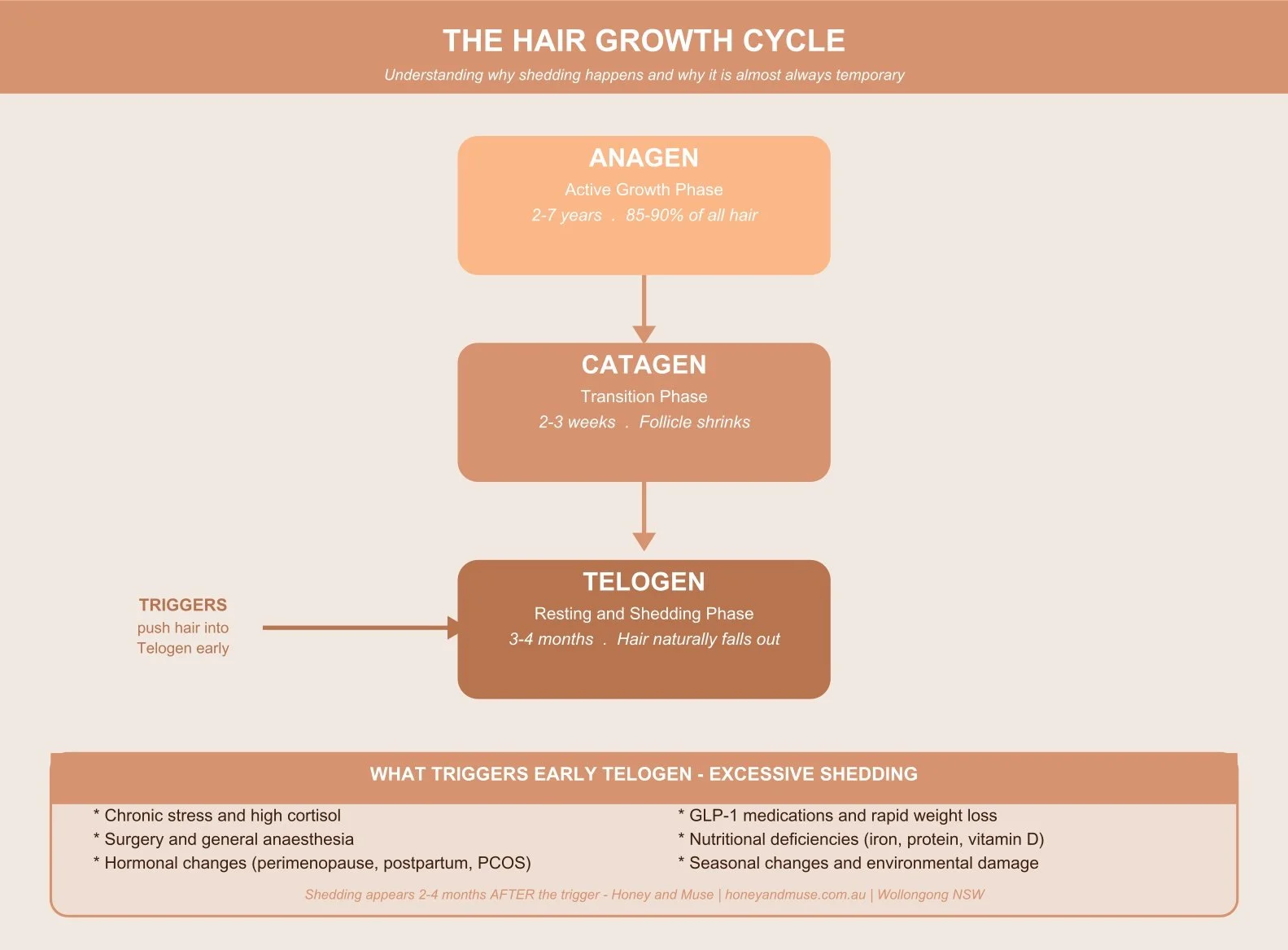
Before we dive in, it helps to understand how the hair growth cycle actually works, because this is why shedding can feel so confusing and out of nowhere. Your hair moves through three phases:
Anagen (active growth, 2-7 years),
Catagen (transition, 2-3 weeks)
Telogen (resting and shedding, 3-4 months).
When your body is under stress, from any of the triggers below, it can push hair into the Telogen phase early.
The result?
A big shed around 2-4 months later. By then, the trigger is long forgotten, which is why it feels so random.
Stress & Cortisol
Chronic stress is one of the most underestimated causes of hair loss in women, and honestly, one of the most common things I see in the salon.
When cortisol levels stay elevated for extended periods, it directly disrupts the hair growth cycle, pushing follicles into the resting (telogen) phase earlier than they should be. This includes emotional stress, burnout, major life events, illness, and even extreme dieting.
The frustrating part? The shedding usually shows up 2-4 months after the stressful period, so by the time you notice it, you've often moved on and forgotten what triggered it.
You're finally feeling better, and then your hair starts falling out. It feels cruel, but it's just the body catching up. Managing stress alongside targeted haircare and good nutrition is key to recovery. It's not just about what you put on your hair, it's about what's happening inside your body.
Post-Surgery & Anaesthesia
This one surprises a lot of people, but it's incredibly common, and I wish more women knew about it before going into surgery. General anaesthesia and the physical trauma of surgery can be a significant trigger for telogen effluvium. Your body goes through enormous stress during a procedure and hair growth is one of the first things it deprioritises while it focuses on healing and recovery.
Most people notice the shedding around 2-4 months post-surgery, which can be really confusing because by that point you've often forgotten about the procedure entirely. You're recovered, feeling great, and then suddenly you're losing handfuls of hair in the shower.
The good news is it's almost always temporary. If you're planning surgery, start supporting your hair health before the procedure, load up on protein, iron, and key vitamins so your body has the reserves it needs.
Seasonal Shedding
Seasonal shedding is a real thing, and it's one of the most overlooked causes of hair loss I see in the salon. Many women notice increased hair fall in autumn and early winter as the body adjusts to changes in light and temperature. It's usually temporary and resolves on its own within a few months. If you notice a pattern of increased shedding around the same time each year, this could absolutely be why.
Hard Water & Environmental Damage
Hard water, UV exposure, pollution and chlorine can all contribute to weakened, stressed hair over time. Hard water in particular builds up mineral deposits on the scalp and along the hair shaft, which can clog follicles and make hair feel dry, brittle and dull.
Signs that environmental damage might be affecting your hair:
• Hair feels dry and dull no matter what products you use
• Colour fades faster than it should
• Scalp feels tight or itchy
• Hair feels coated or heavy
A good clarifying treatment and scalp scrub can work wonders.
Hair Loss vs Hair Breakage | Do You Know the Difference?
Hair shedding happens from the root, linked to stress, hormones, surgery, nutrition, seasonal changes.
Breakage happens along the strand itself. Think: short snapped pieces around the crown, dry ends that won't grow, or hair that feels brittle and fragile.
Here's an easy way to tell the difference: pick a fallen hair and look at the end. If there's a small white bulb at the root, that's a shed hair. If there's no bulb and it's a short broken piece, that's breakage.
Another telltale sign of breakage? If your hair feels stretchy or elastic when it's wet, that's a sign the protein structure is compromised. It needs strengthening treatment, not just moisture.
What Causes Weak, Breakage-Prone Hair?
Weak hair rarely happens overnight. The most common causes we see in salon:
• Over-lightening and bleach damage
• Excessive heat styling without protection
• Tight hairstyles causing tension on the strand
• Hormonal changes affecting hair texture
• Hard water and environmental damage
• Skipping trims for way too long
• Using supermarket haircare that strips the hair
The good news? Breakage is very treatable with the right approach, bond builders, strengthening treatments, moisture and reducing mechanical damage all make a significant difference.
Jess's Pro Tips: What I Recommend
These are the things that have genuinely made a difference, both for me personally and for the clients I work with every day.
Manage Your Stress …. Seriously!
Whether that's daily walks, better sleep, reducing your load, or just giving yourself permission to slow down, your hair will thank you. Cortisol is one of the biggest disruptors of the hair growth cycle.
Support Your Body Before and After Surgery
Load up on protein, iron, zinc and B vitamins in the weeks leading up to surgery. Then continue supporting your body through recovery with good nutrition, hydration and a scalp-focused routine.
Use a Clarifying Treatment Regularly
If you swim, live in an area with hard water, or spend a lot of time outdoors, a regular clarifying shampoo or scalp scrub is a game changer. I recommend doing this once a month or as needed.
Scalp Massage — Don't Skip It
Whether you're applying an oil, or just washing your hair, take 2-3 minutes to massage your scalp. It stimulates blood circulation which means better nutrient delivery to the follicle. It's free, it works, and it feels amazing.
Be Gentle With Wet Hair
Use a wide-tooth comb only, avoid tight styles, and pat dry rather than rubbing. When hair is already weakened, rough handling makes everything worse.
In-Salon Scalp Treatment
Includes a scalp salt scrub, targeted oil application, head massage and head steamer, all designed to deeply nourish the scalp, stimulate circulation and support healthier hair growth from the root.
Book your Scalp Treatment here
Not sure what you're dealing with?
Book a consultation and Jess will assess your hair, talk through your history and build a personalised plan. Every consultation is 1:1 with Jess, completely dedicated to you.
Jess's Recommended Products
These are the products I personally use and recommend. They work, and I wouldn't put my name behind them if they didn't.
1. MONAT IR Clinical™ Hair Thinning Defense SerumMy
Go-to scalp serum for thinning and shedding. Lightweight, non-greasy and absorbs straight into the scalp. Key ingredients include caffeine to energise the follicle, CAPIXYL™ to support hair density, pea extract to strengthen strands at the root, and melatonin to support scalp health.
• Helps reduce hair fall by up to 92%*
• Supports fuller-looking hair in as little as 60 days*
• Perfect for: thinning hair, fragile strands, daily scalp care
Shop the MONAT IR Clinical Hair Thinning Defense Serum here
2. MONAT REJUVENIQE® Oil Intensive
A blend of 13+ plant and essential oils that deeply nourish the scalp and hair fibre. I use it as a pre-shampoo scalp treatment — massage in, leave for 10-20 minutes, then wash out. Also gorgeous as a finishing oil on the mid-lengths and ends.
• Strengthens strands and boosts shine
• Nourishes and hydrates the scalp deeply
• Perfect for: dry scalp, brittle ends, frizz and pre-shampoo treatment
Shop the MONAT REJUVENIQE Oil Intensive here
3. MONAT REJUVABEADS® Split End Mender
Your best friend for breakage at the ends. A lightweight leave-in treatment that visibly smooths and seals split ends, reduces friction along the hair fibre and leaves hair looking healthier, without any heaviness.
• Visibly smooths and seals split ends instantly
• Lightweight leave-in, no rinse needed
• Perfect for: split ends, dry lengths, colour-treated or heat-styled hair
Shop the MONAT REJUVABEADS Split End Mender here
4. MONAT Purify Exfoliating Scalp Scrub
This is a game changer for anyone dealing with product build-up, hard water residue or a congested scalp. The MONAT Purify Exfoliating Scalp Scrub gently removes build-up from the scalp and follicles, think of it as a deep clean that gives your other scalp products a better chance to actually work. I use it as part of my pre-shampoo routine and the difference in scalp health is noticeable.
Gently exfoliates and unclogs follicles
Removes mineral and product build-up
Creates the ideal environment for healthy hair growth
Perfect for: oily scalp, hard water build-up, anyone using scalp oils
5. Keune Care Long & Strong Range
Formulated specifically for weak, fragile and thinning hair, sulphate-free, scalp microbiome-friendly and dermatologically approved. Clinical results show 94% of users experience less hair loss and new growth after just 60 days.
• Strengthening Shampoo - reduces breakage, improves density
• Strengthening Conditioner - lightweight yet intensive, ideal for fragile regrowth
• Densifying Leave-In Treatment Cream - stimulates the scalp and provides up to230°C heat protection
Available in-salon at Honey and Muse — ask us at your next appointment!
Frequently Asked Questions
Can stress really cause hair loss?
Absolutely. Chronic stress is one of the leading triggers of telogen effluvium. Managing stress alongside targeted scalp care and good nutrition is key to recovery.
Why is my hair falling out after surgery?
Surgery and anaesthesia are a significant physical stress. Hair growth gets deprioritised during recovery, triggering telogen effluvium around 2-4 months post-procedure. It's almost always temporary.
Is seasonal hair loss normal?
Yes, many women experience increased shedding in autumn and winter. It's usually temporary and resolves on its own.
How do I know if I have breakage or hair loss?
Look at the fallen hair. A white bulb at the root = shedding. No bulb, short broken piece breakage. If your hair feels stretchy when wet, that's a sign of breakage.
Can hard water affect my hair?
Yes, hard water builds up mineral deposits on the scalp and hair shaft over time. A regular clarifying treatment and scalp scrub can help significantly.
Ready to give your hair some LOVE?
Book your scalp treatment or consultation at Honey and Muse in Wollongong, let's build a plan that actually works for you.
About the Author
Jess Ballinger — Owner & Director, Honey and Muse Salon
Jess is a Wollongong-based hairdresser, salon owner and hair health advocate with 17 years of experience and 12 years running her own boutique salon. Having personally experienced hormonal hair loss, Jess brings both professional expertise and deep empathy to every client consultation.
Honey and Muse · honeyandmuse.com.au · Wollongong, NSW